
What Is a Flywheel Blaster? A Beginner's Guide
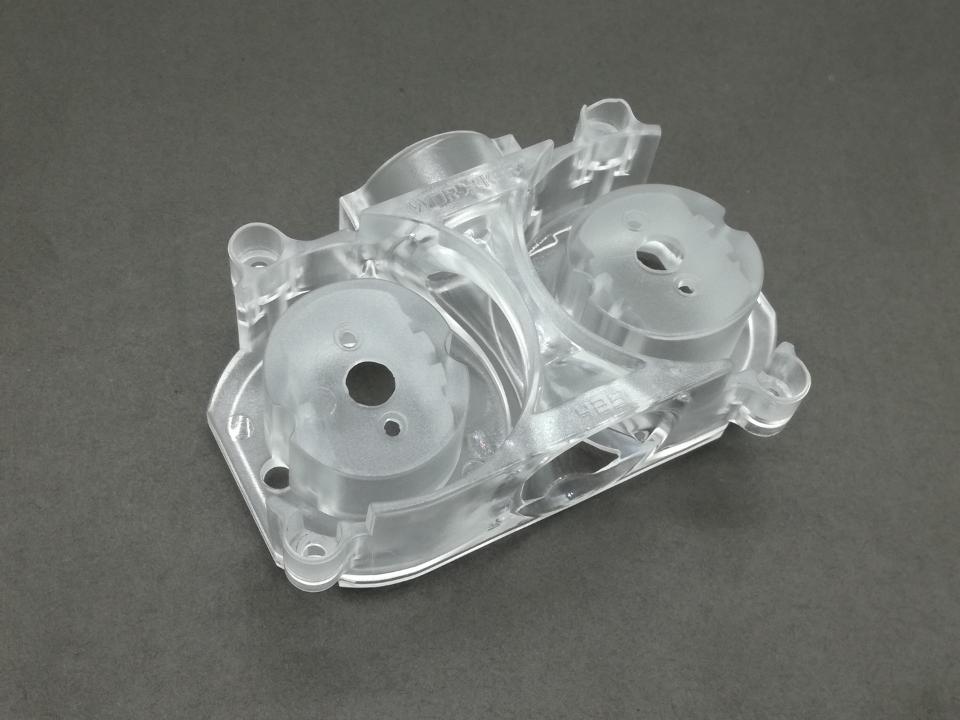
A Nerf flywheel cage is the pair of motor-driven wheels that grab a foam dart and throw it. There is no plunger and no stored spring energy on the shot itself: the motors spin the wheels up, you hold a rev trigger (or the cage stays live), and the pusher or belt feeds a dart into the pinch. That is why flywheels can fire as fast as you can feed them, and why they need a battery, a cage that stays aligned, and darts of the length the feed path was built for.
How the cage actually launches a dart
Two wheels sit in a rigid cage, a few millimetres apart. Each wheel is pressed onto a motor shaft. When the motors run, the wheels turn toward each other. A dart arriving from behind is pinched, accelerated in a few centimetres, and leaves the front of the cage already spinning slightly from any mismatch between the wheels. The gap between the wheels — hobbyists call it crush — is the whole tune. Too little crush and the dart slips, leaving slowly with a chewed foam tail. Too much crush and the motors labour, the dart deforms, and range falls even though the motors sound angry.
The cage is not a barrel. It only has to hold the two motors parallel and keep the pinch centred on the dart. A cage that is cracked, loosely screwed, or fitted with mismatched wheels will throw left, right, or high as the dart leaves at an angle. That is a mechanical problem, not a “weak battery” problem, and it is why a flywheel that used to group well can start spraying after a drop.
What the battery and motors are doing
Each motor is a small DC can. Voltage sets how fast it wants to spin; current is what it draws while fighting crush and dart mass. A pack that cannot hold voltage under that load sags: the wheels slow between shots, the next dart gets a weaker pinch, and you feel it as inconsistent range rather than a dramatic failure. That is why flywheel players talk about connectors, wire thickness and a MOSFET — they are trying to keep the motors at the voltage the cage was designed around, not chasing a magic cell count.
Use only the battery and charger named for the exact blaster, or a complete documented configuration. Cell count (2S, 3S) is not a shopping code you can copy from another model. A pack that physically fits can still over-speed motors, overheat a stock trigger switch, or refuse to seat in the bay. Never charge unattended, and retire a swollen, leaking, hot or damaged pack.
Rev time, trigger and feed
Unlike a springer, a flywheel does not store the shot in a spring. The wheels need to be at speed before the dart arrives. On a two-stage trigger the first pull spins the cage and the second feeds; on a single trigger or a full-auto setup the cage may already be spinning. If you dump a dart into a cage that is still spooling up, that dart leaves slow and often tumbling. That is not a dart-quality issue — it is timing.
The feed path has to match dart length. Full-length Elite-style darts and half-length short darts are not interchangeable. A cage and pusher built for short darts will chew or jam a full-length dart, and the reverse usually will not chamber. Hasbro’s own Pro half-dart magazines are not even all cross-compatible with one another, which is a useful reminder: “half dart” is a family, not a standard you can mix blindly. Match the magazine, the pusher stroke and the dart, then keep that combination together.
Flywheel versus springer, in practice
| Flywheel | Springer | |
|---|---|---|
| Energy source for the shot | Spinning wheels, powered by a battery | A spring-loaded plunger, one prime per shot |
| Rate of fire | Limited by feed and motors, not by your arm | Limited by how fast you can prime |
| Sound | Rev whine before and during the string | A mechanical clack; quieter between shots |
| Main failure modes | Voltage sag, worn wheels, cage screws, dart length mismatch | Air leak, worn catch, tired spring, bad dart seal |
| What you carry extra | Charged pack, charger, spare mag of the matching dart | Spare darts; no pack if it is a pure springer |
A compact flywheel pistol such as the Hare Diana exists to give that rate of fire in a holsterable package. A slam-fire springer such as the XYL KM9 Unicorn is the opposite idea: no motors, a Talon-style magazine, and a prime you feel in your forearm. Neither is “the flywheel blaster”; they are different machines. The wider comparison of air, wheels and springs lives in HPA vs flywheel vs springer.
Who a flywheel actually suits
Choose a flywheel if you want volume of fire, you will keep a charged pack, and you are willing to treat darts and magazines as a matched set. Skip it as a first blaster if you only play mixed-age backyard games with whatever foam is in the bin — a simple springer will jam less on mixed ammo and needs no electrical habits. If you do buy a flywheel, the first upgrades that usually matter are darts that actually fit, a cage that is screwed down, and wiring that does not sag. Motors come after that. See the upgrade-parts order before spending on cans.
Frequently Asked Questions
Is a flywheel blaster just a motorised springer?
No. A springer stores energy in a spring and dumps it through a plunger as a pulse of air. A flywheel never uses that pulse; the dart is thrown by friction against spinning wheels. That is why flywheels need a battery on every shot and springers do not.
Why does my flywheel chew darts?
Usually crush, dart length or a cage that is no longer parallel. A dart that is too long, too fat, or already banana-shaped will stall in the pinch. Worn or glazed wheels slip and then bite. Fix the feed and the cage before buying hotter motors — hotter motors on a bad pinch shred foam faster.
Do I need a MOSFET on a stock flywheel?
Not automatically. A MOSFET is a switch that keeps motor current off the trigger contacts. Stock current on a mild cage may be fine for a long time. It becomes important when you raise current (hotter motors, higher voltage, full-auto dumps). Do not fit one unless the exact platform and component documentation support the complete setup. The electronics are explained in what a MOSFET does.
Can I run any LiPo in a flywheel cage?
No. Use the pack the blaster names, or a documented equivalent for that cage, connector and bay. Voltage, plug, physical size and discharge capability all have to match. A 3S pack from another hobby is not a drop-in upgrade.