

The Free-Spin RPM Trap: Why Faster Mini 4WD Motors Often Lose on Track
Acoustic free-spin RPM numbers ignore Back-EMF collapse and load torque. Here is why brushed DC motor power peaks at half no-load speed and how over-gearing cooks Dash motors.
 Click to zoom
In stock
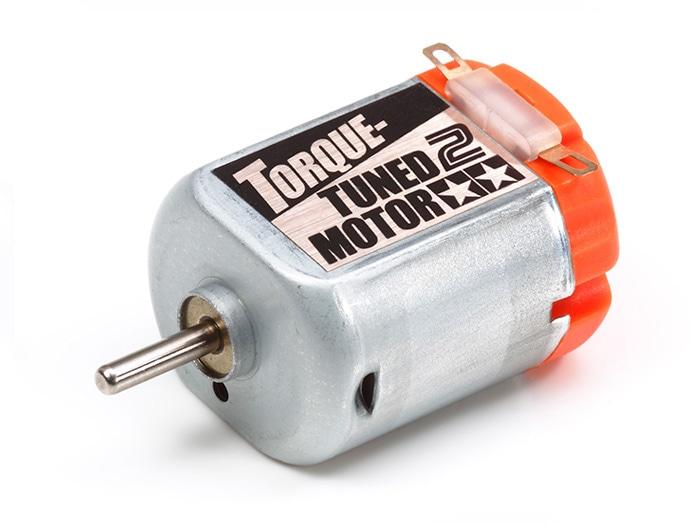
Part of Tamiya's second-generation Tuned Motor line-up, the Torque-Tuned 2 is set up for strong acceleration and minimal speed loss through slopes and corners, making it a good match for technical, tightly-cornered circuits rather than long straights. A pinion gear is not included and must be fitted separately. It is the non-PRO counterpart to the Torque-Tuned 2 Motor PRO: this standard version is tagged for Mini 4WD cars (excluding Mini 4WD PRO) and Dangun Racers, across chassis from Type 3 through Super TZ-X, VS, AR and VZ, while the PRO version is built specifically for MS, MA and ME Chassis cars and runs a slightly higher torque band. Within Tamiya's own published figures the two are close but not identical, so the standard Torque-Tuned 2 should not be swapped onto a PRO chassis expecting identical output.
Acoustic free-spin RPM numbers ignore Back-EMF collapse and load torque. Here is why brushed DC motor power peaks at half no-load speed and how over-gearing cooks Dash motors.

Torque-Tuned 2, Atomic-Tuned 2 and Rev-Tuned 2 are the first published upgrades: RPM, torque and current, and which course type each is built for.

Choose a layout and maintenance approach, then budget for the exact kit and compatible parts. A front motor alone does not guarantee better landings.