

The Free-Spin RPM Trap: Why Faster Mini 4WD Motors Often Lose on Track
Acoustic free-spin RPM numbers ignore Back-EMF collapse and load torque. Here is why brushed DC motor power peaks at half no-load speed and how over-gearing cooks Dash motors.
 Click to zoom
Out Of Stock
This product is currently unavailable.
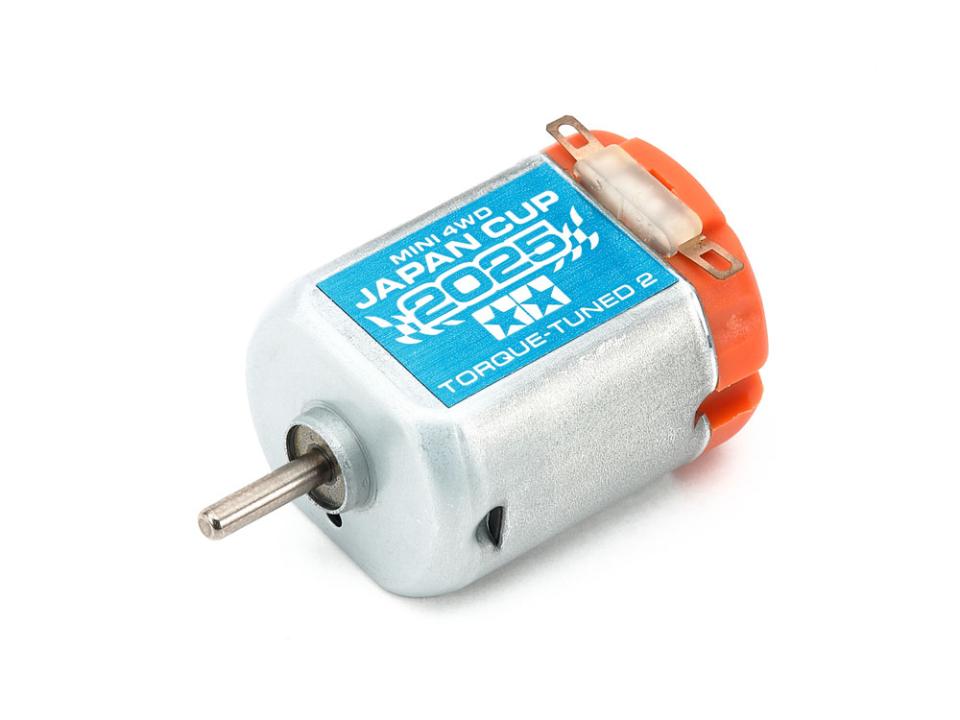
Browse available alternativesA Japan Cup 2025 commemorative edition of the Torque-Tuned 2, a single-shaft motor built for technical courses — its torque-oriented winding holds power well through corners and up inclines, and it uses a metal-plate brush for electrical efficiency. The backing card and label carry Japan Cup 2025 branding, with a blue-green label in silver text and an orange end bell.
It went on sale around 12 July 2025 alongside a wider Japan Cup 2025 commemorative line-up that also included the Hyper-Dash 3 Motor J-CUP 2025, HG Carbon Multi-Reinforced Plate (1.5mm) J-CUP2025 and HG Carbon Rear Roller Stay (1.5mm) J-CUP2025, all sharing the same event branding so a car can be built entirely from matching commemorative parts. As a torque-type motor rather than a speed-type one, it's the pairing racers reach for on tight, technical layouts with corners and inclines rather than long straights.
Acoustic free-spin RPM numbers ignore Back-EMF collapse and load torque. Here is why brushed DC motor power peaks at half no-load speed and how over-gearing cooks Dash motors.

Torque-Tuned 2, Atomic-Tuned 2 and Rev-Tuned 2 are the first published upgrades: RPM, torque and current, and which course type each is built for.

Choose a layout and maintenance approach, then budget for the exact kit and compatible parts. A front motor alone does not guarantee better landings.