
Gel Blaster Trigger Switch: How It Works & When to Upgrade
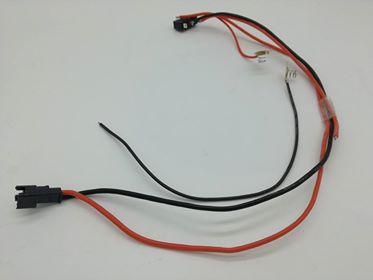
The gel blaster switch — usually a pair of trigger contacts inside the gearbox — on pistol-style blasters, often a small microswitch down in the grip — is the part that completes the circuit and sends power to the motor every time you pull the trigger. It's a small, cheap part, but it's also one of the first things to wear out on a blaster that gets played hard, and it's frequently confused with the MOSFET.
What the switch actually does
Pull the trigger and a mechanical contact (in most stock setups, two metal plates or a small microswitch) closes, letting the full battery current flow through to the motor. Every amp the motor draws to spin the gear train passes straight through those contacts. That's the switch's whole job: a simple, mechanical on/off gate for motor current.
Switch vs. MOSFET: not the same part
These two get mixed up constantly. The trigger switch is the mechanical contact that starts the circuit; a MOSFET is a solid-state component that sits between the switch and the motor and takes over carrying the heavy current, so the switch only has to handle a small signal current instead. Think of the switch as the button and the MOSFET as the relay it's telling what to do — you can run a switch without a MOSFET, but a MOSFET setup still needs a switch (or equivalent trigger sensor) to tell it when to fire.
| Trigger switch | MOSFET | |
|---|---|---|
| Job | Mechanically starts/stops the circuit | Carries the heavy motor current, protected from arcing |
| Wears out from | Repeated arcing and contact pitting | Rarely wears; can fail from a wiring fault or overload |
| Fixes | Weak or intermittent trigger response | Trigger contact burn-out, faster response (advanced units add battery protection) |
Signs your switch is on its way out
- Intermittent firing — the blaster fires on some pulls and not others with no other change.
- A trigger that needs a harder pull to get a response, as contact surfaces pit and lose clean contact.
- Visible arcing marks or discolouration on the contacts if you open the grip — a sign of current arcing across the gap every time it opens and closes.
Every time the switch opens under load, a small spark (arc) jumps the gap and slowly burns the contact surface. That's the wear mechanism, and it's also exactly what a MOSFET exists to prevent — by moving the heavy current off the switch entirely.
Replace, upgrade, or add a MOSFET?
If your existing switch still makes clean contact, a direct replacement is the simplest fix. If you're seeing repeated wear or want to stop the problem long-term — especially on a build with a heavier spring or higher-draw motor — adding a MOSFET is the upgrade that actually addresses the cause, not just the symptom. See our MOSFET guide for when you actually need one.
Frequently Asked Questions
What is the switch on a gel blaster?
It's the trigger contact — usually a small pair of metal contacts or a microswitch inside the gearbox, behind the trigger — that closes to complete the circuit and send power to the motor when you pull the trigger. It's a purely mechanical part, separate from any electronics like a MOSFET.
Is a gel blaster switch the same as a MOSFET?
No. The switch is the mechanical contact that starts the circuit; a MOSFET is a solid-state component that takes over carrying the motor's heavy current so the switch only handles a small signal instead. A MOSFET setup still needs a switch to tell it when to fire — they work together, not as alternatives.
Why does my gel blaster fire intermittently?
Intermittent firing with no other change usually points to a worn or pitted trigger switch. Repeated arcing across the contacts every time they open under load slowly burns the surface, giving weaker or unreliable contact over time. Check for visible arcing marks before assuming the issue is deeper in the gearbox.
Do I need a MOSFET if my switch keeps wearing out?
It's the most effective long-term fix. A MOSFET moves the heavy motor current off the trigger switch entirely, which stops the arcing that wears the contacts down in the first place. If you're replacing a burnt-out switch more than once, a MOSFET addresses the cause rather than the symptom.
Related reading
Start with the full guide: Gel Blaster Modding: The Complete Upgrade Roadmap.