
Why Looser Parts Shoot Faster: Bamboo Darts & Floating O-Rings
Tighter does not automatically mean faster in a sealed-breech springer blaster. Once an air seal prevents pressure from leaking past a foam dart or piston head, squeezing harder only converts stored spring energy into sliding friction. That counter-intuitive trade-off is the reason grooved bamboo darts and loosely seated “floating” plunger O-rings regularly outperform tight-fitting conventional parts in high-power springers.
Understanding the mechanics keeps you from chasing the wrong fix—such as forcing soft straight foam into an overly tight brass barrel, boiling darts into deformed grooves, or coating elastomer seals with petroleum grease that swells rubber until the plunger binds.
Why tighter barrel fit can actually drop FPS
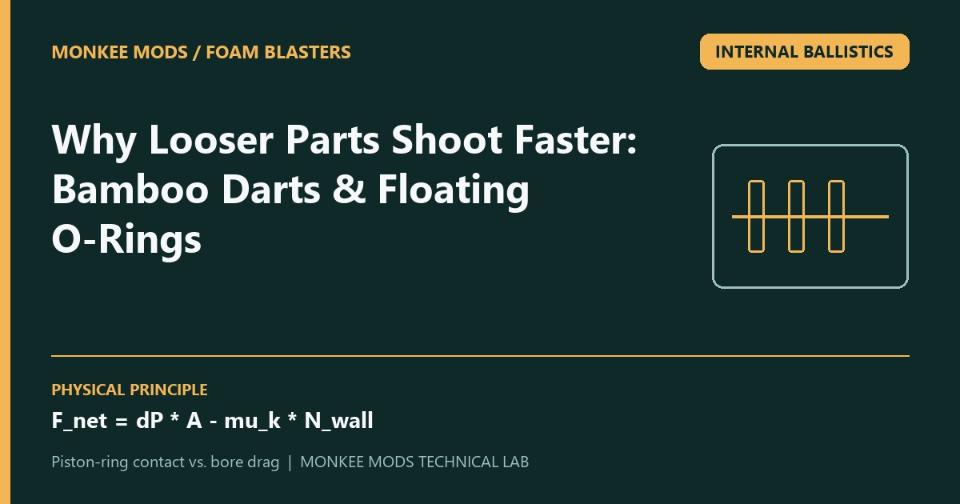
In a spring-piston blaster, the compressed main spring drives a plunger forward, pressurizing air behind the dart inside a sealed breech. That air pressure accelerates the dart down the barrel while also pushing outward against the flexible walls of the hollow foam body. The net forward force on the dart at any point in the barrel is driving pressure force minus barrel wall friction:
Fnet = (Prear − Patm) Abore − μk Nwall
If the barrel bore is too loose, pressurized air escapes around the foam before the dart builds speed. If the bore is overly tight relative to the foam’s outer diameter, static breakaway friction and dynamic wall drag eat into acceleration—especially near the muzzle once the air column expands and driving pressure drops. Because real dart foam varies slightly between brands, batches, and wear states, a barrel tuned on the edge of binding with fresh straight darts can stall or produce wide FPS spreads as soon as foam swells or picks up grit.
Bamboo darts as pneumatic piston rings
Grooved short darts—such as Worker Gen 2 HE bamboo-profile darts or Monkee Mods’ bamboo half-dart lines—step down portions of the foam cylinder between raised ridges. Instead of dragging a full-length 13 mm foam sleeve against the bore wall, only those narrow circumferential bands maintain sliding contact.
Mechanically, those raised bands behave like piston rings on a compressor or small engine. Each ridge creates a localized seal against the barrel wall to block blow-by while slashing total foam-to-metal contact area. Less wall contact reduces kinetic drag without sacrificing the pressure boundary behind the dart. On high-volume springers such as the Worker Harrier or Seagull, lower friction also pairs naturally with longer barrels where straight-walled foam would decelerate near the muzzle.
This mechanism also explains why DIY “bambooing” experiments—clamping straight darts in heated molds or boiling water—often disappoint. Heating open-cell foam unevenly or letting it cool under compression frequently shrinks the overall dart diameter below the barrel bore. When even the raised ridges lose contact, the dart drops through the barrel with blow-by rather than sealing like a piston ring. Factory-molded bamboo darts control both the crest diameter and groove depth consistently, though exact results still vary by barrel internal diameter and dart batch.
| Component | Conventional tight fit | Friction-managed design | Mechanical trade-off |
|---|---|---|---|
| Dart body geometry | Continuous straight cylinder contacting full bore wall | Grooved bamboo ridges acting like narrow sealing rings | Lower bore drag, though overly loose bores need crest contact |
| Plunger head O-ring | Pre-stretched tight squeeze against tube wall | Floating O-ring with radial clearance inside groove | Minimal prime/startup drag; requires clean groove depth and air seal |
| Barrel bore tolerance | Tight 17/32″ brass (~12.75 mm ID) | Standard 13.0 mm aluminum hobby barrel | Brass maximizes seal on uniform darts; aluminum resists denting and dirt |
| Seal lubricant | Dry rubber or petroleum oil | Pure silicone grease (e.g., Super Lube silicone) | Silicone protects elastomer geometry; petroleum oils swell nitrile seals |
How a floating plunger O-ring seals under pressure
New builders are often surprised when they open a tuned springer plunger tube and notice the piston O-ring can rattle slightly in its gland. In a static hand check with zero airflow, a tight pre-crushed O-ring feels airtight—yet during an actual shot, that constant rubber-to-cylinder squeeze wastes spring energy before the piston even reaches peak speed.
A floating O-ring uses an intentional radial clearance between the bottom of the piston groove and the inside diameter of the O-ring, paired with a slightly wider axial groove width. While you prime the blaster—or during the first milliseconds after releasing the catch—the O-ring sits lightly against the plunger wall with low drag. As the plunger compresses air ahead of it, pressure enters the space behind the O-ring in the groove and forces the elastomer outward against the cylinder wall and backward against the rear gland wall. Seal contact force scales dynamically with chamber pressure, matching engineering gland-clearance principles described in industrial seal references like the Parker O-Ring Handbook.
For a floating O-ring to work, the plunger groove must remain clean and free of burrs, and the O-ring cross-section must match the cylinder diameter closely enough that an initial seal engages as soon as the piston accelerates. A worn, nicked, or undersized O-ring will simply blow air past before pressure can seat it.
Brass vs. aluminum barrels and elastomer lubrication
Barrel material changes both tolerance and maintenance behavior. Thin-wall 17/32″ brass tubing offers tight internal tolerances that maximize pneumatic efficiency on uniform darts, which is why modders have used nested brass breeches for years—yet soft brass dents easily from field drops and binds quickly if foam residue or grit builds up. Anodized or machined 13 mm aluminum barrels, as fitted on platforms like the Worker Harrier, Worker Seagull, and FL Thunder, prioritize rigid concentricity and smoother wear resistance across mixed dart batches.
Seal chemistry is just as unforgiving as bore fit. Standard hobby O-rings are commonly nitrile (Buna-N) or polyurethane. Applying petroleum-based oils, aerosol solvents, or automotive penetrating sprays attacks nitrile elastomers, causing them to soften, swell, and pinch inside the plunger tube—which feels like a sudden loss of prime smoothness followed by plummeting FPS. Using a thin film of synthetic silicone grease keeps friction low without chemically altering common O-ring compounds. Keep lubricant strictly inside the plunger cylinder; never coat the inside of a dart barrel with wet grease, which collects dust and transfers slick residue onto foam and flywheels.
Frequently asked questions
Do bamboo darts always shoot faster than straight darts in every blaster?
No. In a sealed-breech springer with a properly matched bore, bamboo ridges reduce sliding friction and often preserve more velocity downrange or through longer barrels. In flywheel blasters, however, stepped grooves alter how the wheel faces grip the foam, and in overly loose bores a smaller effective contact surface can lose air seal.
Why does my floating O-ring feel loose when I push the plunger slowly by hand?
A floating O-ring relies on rapid piston speed and air-pressure build-up inside its groove to expand radially against the cylinder wall. Testing slowly by hand does not generate that pressure spike, so a healthy floating seal often feels slightly leaky at crawling speed while sealing crisply when fired.
Can I use WD-40 or petroleum oil on my blaster O-rings?
No. Petroleum-based oils and common multi-purpose sprays can swell, soften, or crack rubber O-rings and degrade certain blaster plastics. Clean old residue completely and apply a light coat of plastic- and elastomer-safe silicone grease.
Related reading
- Nerf Dart Types Explained: A Modder's Guide
- Foam Dart Weights Explained: A Modder's Guide
- Nerf Spring Ratings Explained: What Do 1.4, 1.6 and kg Tell You?
- SCAR vs BCAR: Which Accuracy Attachment Should You Buy?
- How to Chronograph a Nerf Blaster: Ten-Shot Testing
Sources
Mechanical and elastomer sealing principles checked 21 November 2026. Specific blaster performance still depends on barrel ID, spring load and dart batch; chronograph your own configuration rather than assuming universal FPS gains.