
Beyblade X Starter vs Booster Guide
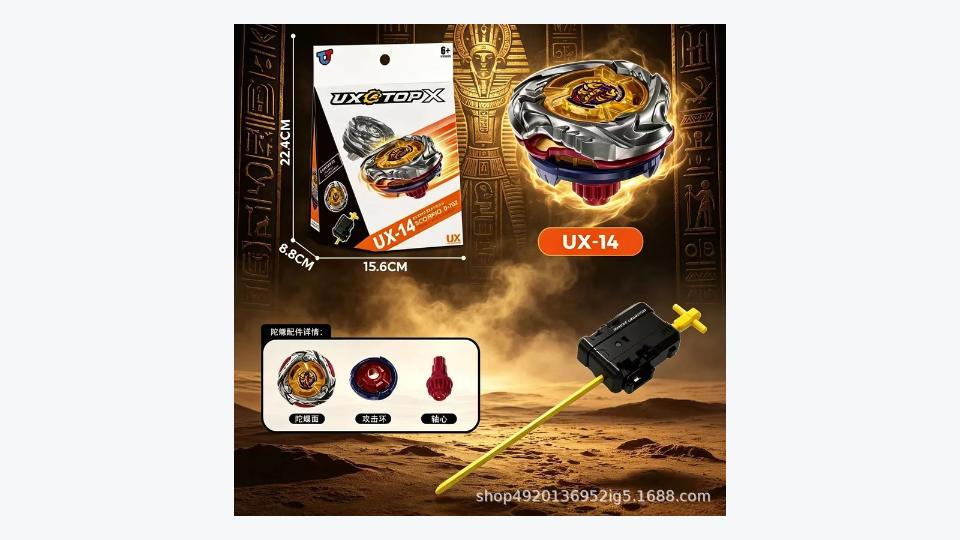
"Starter" and "Random Booster" are Takara Tomy's own product categories for Beyblade X, and they carry the BX-, UX-, or CX- prefix depending on which generation of parts is inside. The difference isn't marketing language — it's what's physically in the box, and it changes what you need to buy alongside it to actually play.
Starter: one complete bey plus a launcher
A Starter (e.g. a BX-numbered Basic Line set) ships one specific, ready-to-launch Beyblade — Blade, Ratchet, and Bit already matched — together with a launcher and the instruction manual. Nothing else needs to be bought to take a first launch; only a stadium is separate. Japanese retail runs roughly ¥1,980-2,750 per Starter depending on the line and box size; Hasbro's English-market sets are commonly listed around $14.99-$19.99, though that range is representative rather than a fixed line-wide price — individual sets and waves vary and we can't confirm one number applies across the board.
Random Booster: parts only, blind-packed
A Random Booster (for example BX-14 Random Booster Vol.1 or CX-08 Random Booster Vol.7) is a blind-box product: each unit contains one of several possible Beyblades or colorways, chosen at random, and no launcher is included at all — you need a stadium and a compatible launcher already in hand before a Booster is useful. They're sold cheaper than Starters, around ¥1,400-1,600 JP per BeyBase, and are packed commercially in master cartons of 24 units split across 4 bags, which is why local shops sometimes sell them "by the case" to guarantee a full spread of the possible variants. Boosters suit players restocking or chasing a specific part more than someone buying their very first bey.
CX added a second kind of "Blade"
Beyblade X's Basic Line (BX) and Unique Line (UX) both use a single-piece Blade; we could not independently confirm exact launch dates for each line beyond the general Beyblade X release window, so treat any specific month/year you see for BX vs UX as approximate rather than a confirmed spec. The Custom Line (CX), Takara Tomy's official name for the newest generation, introduced a 3-piece Blade instead: a Lock Chip, a Main Blade, and an Assist Blade, combined with the usual Ratchet and Bit. CX Starters ship a Winder or Ripcord Launcher, as earlier BX/UX Starters did; string launchers have always been separate accessories rather than Starter pack-ins. CX-01 DranBrave is one early CX Starter example; exact component notation codes for individual CX releases vary between waves and are worth checking against the current official line-up rather than trusting a code repeated secondhand. Because CX parts are a different physical format from BX/UX parts, mixing generations isn't always a given — check compatibility notes before assuming a CX Blade drops onto older gear.
Product codes, contents, and regional pricing all shift between waves, so it's still worth confirming the specific listing or box contents before a tournament or a purchase, rather than relying on the generation name alone.
If you're weighing up a first purchase, the first deck guide and the beginner's guide for Malaysia pick up where this comparison leaves off.
Frequently asked questions
What is the difference between a Beyblade X Starter and a Booster?
A Starter ships one specific, ready-to-launch Beyblade with Blade, Ratchet and Bit already matched, together with a launcher and the instruction manual, while a Random Booster is a blind-box product containing one of several possible Beyblades chosen at random and no launcher at all.
Which should a first-time player buy?
A Starter, because nothing else needs to be bought to take a first launch apart from a stadium, whereas a Booster only suits players who already have a compatible launcher in hand.
What launcher comes with CX Starters?
CX Starters ship a Winder or Ripcord Launcher, as earlier BX/UX Starters did; string launchers have always been separate accessories rather than Starter pack-ins.
Can CX parts be mixed with BX or UX parts?
Not always. CX parts are a different physical format from BX and UX parts, so it is worth checking compatibility notes before assuming a CX Blade drops onto older gear.
Sources, safety and catalogue wording
This guide uses the official Beyblade X guide, the official gear guide, the current official line-up and the official manual hub as references. Follow the package instructions and Beyblade X safety guidance: use Beyblade X tops only in an appropriate Beyblade X stadium, and keep faces and hands clear before launching.
Official product names and codes on this page identify reference releases. Monkee Mods catalogue listings may describe compatible or style items; they are not made by, affiliated with, or endorsed by Takara Tomy. Product availability, package contents and event eligibility can change, so confirm the exact listing and ask the organiser before an event.