
Gel Blaster Gearbox Diagram: A Labeled Parts Guide
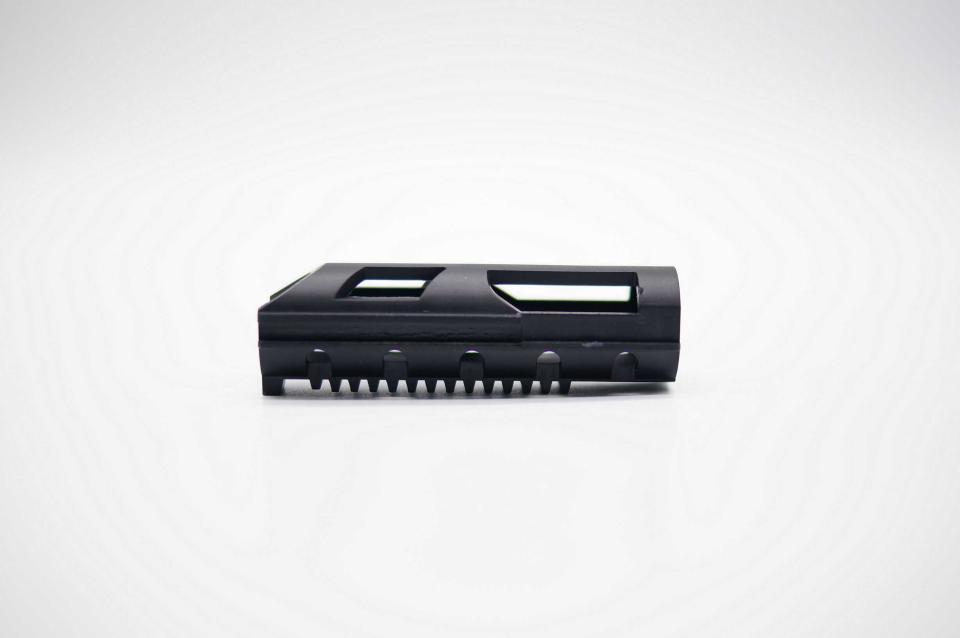
A gel blaster gearbox diagram is the fastest way to stop guessing part names when you're troubleshooting or ordering a spare. Most V2-style AEG gearboxes share the same layout regardless of brand, so once you can name the pieces on a diagram, you can follow almost any repair thread or parts listing without getting lost.
The gearbox shell and drive train
Open the shell and the first thing you see is the drive train: the motor turns the bevel gear, which turns the spur gear, which turns the sector gear. The sector gear is the one with a partial set of teeth cut away — it engages the piston rack for one full cycle per rotation, then releases it. These three gears sit on fixed metal shafts (posts) inside the shell, and thin shims on each axle set the gears' side-to-side play so the teeth mesh cleanly without binding.
| Part | What it does |
|---|---|
| Bevel gear | First gear the motor pinion drives; sets the overall gear ratio with the other two |
| Spur gear | Middle gear, passes drive from the bevel to the sector |
| Sector gear | Drives the piston back, then releases it forward on the toothless section |
| Anti-reversal latch | A spring-loaded catch that engages the bevel gear's ratchet teeth and stops the gear train running backwards under spring tension |
The compression assembly
Behind the gears is the part that actually launches the gel ball: the piston, pulled back by the sector gear and pushed forward by the main spring, compresses air in the cylinder. That air is forced through the cylinder head and air nozzle into the barrel behind the ball. The tappet plate carries the air nozzle, and its job is timing: a cam on the sector gear pulls it back so the nozzle clears the feed path and a fresh gel can rise into the hop-up chamber, then its spring returns it forward so the nozzle seats and seals before the piston fires — all in the same cycle.
Reading a diagram without a reference photo in front of you
- Work back from the barrel. Barrel → hop-up → air nozzle → cylinder head → cylinder → piston. That's the air path, and it's the same order on almost every V2-style gearbox.
- The gears are always three, in a line. Bevel closest to the motor, sector closest to the piston rack, spur in between.
- Small spring-loaded parts are usually the anti-reversal latch and the trigger contacts — easy to mix up in a photo, but the latch sits against the bevel gear's ratchet teeth and the contacts sit near the trigger.
Diagrams vary slightly between manufacturers — some split the tappet plate and nozzle into one moulded part, others keep them separate — so treat a diagram as a map of the concept, not a guaranteed match to your exact gearbox parts.
When you actually need to open the gearbox
Most feeding, range and noise problems trace back to the barrel, hop-up or gel quality rather than the gearbox itself — see our not-firing troubleshooting guide before you reach for a screwdriver. If the symptoms point inside (grinding, a dead click with no cycle, a cracked shell), that's the point to move on to a full gearbox upgrade guide or a shimming pass.
Frequently Asked Questions
What are the three main gears in a gel blaster gearbox called?
Bevel, spur and sector, in that drive order from the motor. The bevel gear meshes with the motor pinion, the spur gear passes drive through the middle, and the sector gear — recognisable by its partial ring of teeth — pulls the piston back and then releases it to fire.
What part feeds the gel ball into the hop-up chamber?
The tappet plate, which carries the air nozzle. A cam on the sector gear pulls it back so the nozzle clears the feed path and a fresh gel can rise into the hop-up chamber, then its spring returns it forward so the nozzle seats and seals before the piston cycles forward, all within the same rotation of the sector gear.
Do all gel blaster gearboxes look the same inside?
Most AEG-style gel blasters use a V2-style gear train, with the same basic layout of bevel, spur and sector gears, a piston and spring, and a cylinder and nozzle assembly, in shells that vary by platform. Exact shell shape, part material and how components like the tappet plate are moulded can differ between brands, so use a diagram as a concept guide rather than an exact match to your unit.
Why does my gearbox diagram not match my blaster exactly?
Manufacturers sometimes combine or split parts differently — for example, moulding the tappet plate and nozzle as one piece instead of two. The core air path and gear order stay consistent across brands, so identify parts by their position and function first, then compare against your specific gearbox before ordering a replacement.
Related reading
Start with the full guide: Gel Blaster Modding: The Complete Upgrade Roadmap.