
Gel Blaster Hop-Up Explained: Range & Accuracy
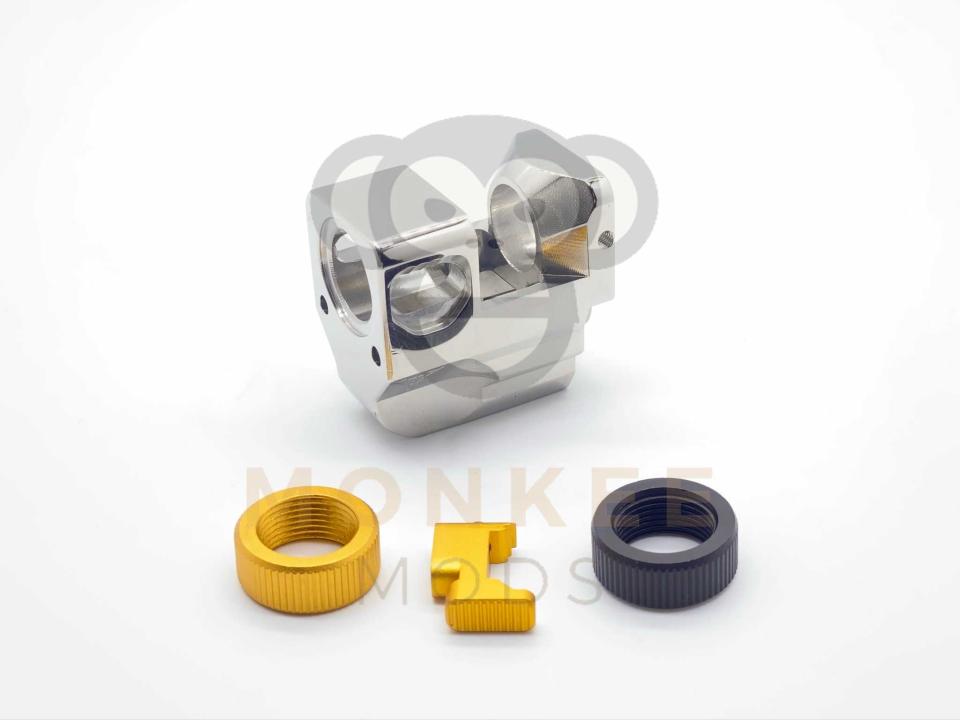
What is a hop up gel blaster setup actually doing? A rubber bucking in the hop-up unit nips the top of the gel as it enters the barrel, imparting backspin. That backspin makes the air under the sphere push harder than the air over it — the Magnus effect — so the gel flies flatter and farther than a non-spinning sphere of the same speed. Too much nip and the gel curves up, stalls and dumps. Too little and it drops early. There is no hop “click” number that fits every unit, and humidity in Malaysia will move the setting for you by softening the rubber.
Bucking, backspin and the Magnus lift
The hop-up sits between the magazine and the inner barrel. As the nozzle seats, one gel is held in the chamber. The bucking — a small rubber sleeve — has a contact patch (often a ridge or flat) at the twelve-o’clock position. Air from the piston drives the gel forward; the patch drags the top of the sphere so the gel leaves rotating backwards. Backspin deflects airflow: higher pressure under the gel, lower pressure above, a lift component that fights gravity for part of the flight.
That patch has to match the bead. An undersize gel barely touches it and gets little spin. An oversize gel jams, smears, or leaves chunks of polymer on the rubber. Ammo matching is not optional; see the ammo guide and grow a sieved test batch rather than copying someone else’s soak time. The rest of the air path — nozzle, tappet plate, piston head — is covered in gel blaster internal parts without repeating that anatomy here.
Over-hop versus under-hop, in the air
Watch the first few metres, not the meme of “max clicks.”
| Flight | Usual cause | What to try first |
|---|---|---|
| Gel rises, hangs, then falls short | Over-hop: too much backspin for that speed and mass | Reduce hop on that unit; do not copy a click count from another blaster |
| Gel leaves flat then dives | Under-hop, or a bead too small to take the patch | Increase hop slightly, or sieve a properly sized batch |
| Left or right curve | Bucking twisted, nub off-centre, dirty barrel | Reseat the bucking; clean the barrel; do not chase it with more hop |
| Random arcs in the same mag | Mixed bead sizes or a wet, swollen bucking | Sieve ammo; let the unit dry; Malaysia humidity is a real variable |
Do not publish or copy a hop click setting as if it were a spring rating. Units differ in nubs, bucking compound, barrel inner diameter and how the adjustment wheel indexes. A setting that works on one Jinming hop-up can over-hop a tighter aftermarket unit on an LDT or LeHui. Tune on a calm day, with the beads you will actually use, and write down the result for that blaster — not for “all V2s.”
Humidity, heat and the rubber
Silicone and rubber buckings soften as they take on heat and moisture. In Malaysian weather that often means more hop at the same mechanical setting after a humid week in a gear bag. The gel starts arcing up even though you “didn’t touch it.” The fix is not a new spring. Dry the unit, inspect the bucking for swelling, glazing or chunks of gel, and back the adjustment off until flight is flat again.
A bucking that is wet with gel mush behaves like a stronger patch: extra drag, extra spin, extra breakage. Clean it as the manual allows — usually a dry or slightly damp swab, not a solvent bath. The cleaning guide covers barrel and bucking care. Do not oil the contact patch; lubricant there kills spin and throws the gel into the crown of the barrel.
Leave hop conservative on a blaster you have not chrono’d at a lawful venue. Extra backspin is not extra energy. There is no Malaysia-wide legal FPS. Organiser limits, where play is lawful, win. Hop is a trajectory tool, not a power upgrade.
Adjustment, jams and when to stop
- Make the launcher safe: magazine out, battery disconnected on an AEG, pointed in a safe direction. Confirm the item and activity are lawful before you test-fire. PDRM reporting has included realistic gel blasters and imitation firearms; safety glasses do not settle that. Legal-status warning.
- Load a sieved, in-spec batch. Mixed sizes will fake a hop problem.
- Start from a low hop setting on that unit. Fire a few shots at a known distance. Watch for rise versus early drop.
- Change one increment at a time. Stop when the flight is flat for that bead and that power, not when the wheel runs out of clicks.
- If gels smear, the gearbox locks, or you hear a crunch, stop. That is a size or lockup problem, not a request for more hop. Do not force the trigger.
Some products are not user-adjustable. If the manual has no hop procedure, do not pry the unit apart because a video showed an M4-style arm. A Kublai GBB pistol is not “the same hop” as a Jinming AEG just because both launch gels. Beads remain a child hazard while you tune: polymer can expand about 100 times; keep gels away from children and pets, and seek urgent care if ingestion or insertion is suspected. Do not call them harmless.
Frequently Asked Questions
Can I copy another player’s hop click setting?
No. Buckings, nubs, barrels and bead sizes differ. Use flight as the feedback: over-hop rises and stalls, under-hop drops early. Humidity will also move a setting that was perfect last month.
Why did my range collapse in wet weather?
Often the bucking softened and over-hopped, or leftover gel mush increased drag. Dry and clean the unit, then re-tune from a low setting. Also sieve the batch — swollen, still-growing beads lock more in humidity.
Which beads should I use with hop-up?
Only the beads and preparation method specified for that launcher, sieved to a consistent diameter. Hop-up cannot correct a mixed bag. Sensory beads such as Orbeez are not ammo.
Does more hop mean more FPS?
No. Hop-up changes trajectory by adding backspin. It does not add a reliable velocity figure and can cost speed if the patch is too aggressive. Chrono, where play is lawful, is a separate measurement with the organiser’s method.