
Beyblade X Tournament Brackets Explained
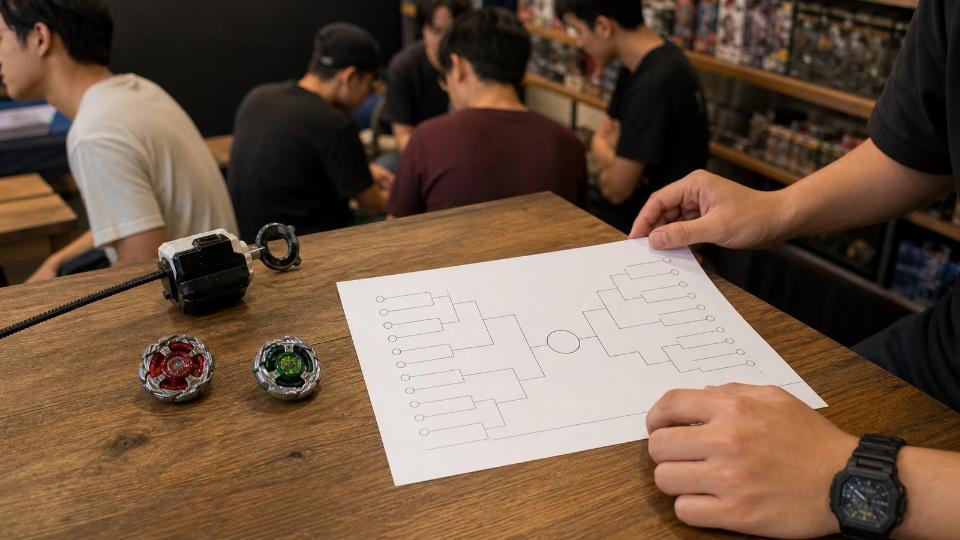
Beyblade X events run on a two-part structure that catches a lot of first-time competitors off guard: most of the day is not a single-elimination bracket at all, and the way a battle ends carries a different point value depending on how decisive it was.
How a battle is scored
Every set is decided by points, not by winning a fixed number of individual battles. A spin finish — your opponent's Beyblade simply stops spinning first while yours is still going — is worth 1 point. A burst finish — one or more parts (Blade, and on CX beys the Lock Chip/Main/Assist Blade, Ratchet, or Bit) detaching mid-battle — is worth 2 points, and so is an over finish, where the opponent's bey is knocked clean out of the stadium through one of the two Over Zone pockets at the stadium's front corners. The most valuable and hardest to land is an Xtreme finish: the bey is sent out with enough force to exit through the Xtreme Zone, the hole at the center front of the Xtreme Stadium (inverted in the Wide Xtreme Stadium), worth 3 points. A set ends once a player reaches a target score — typically 4 points: WBO's default 4-Point Match Type is first-to-4 through every stage of an event, and 7-Point is a separate Match Type some ranked events choose for the whole event rather than a finals-stage raise — which rewards players who can consistently force bursts and overs rather than grinding out spin finishes one at a time.
Swiss rounds before the bracket
The single-elimination picture most players have in their head — lose once and you're out — only describes the last stage of a typical event. Real tournaments — the kind sometimes tracked publicly on bracket platforms like Challonge — commonly open with several rounds of Swiss pairing: players are matched against others with similar records instead of being eliminated after a single loss, so one bad launch early on doesn't end your day. Once the Swiss rounds settle the standings, the top finishers move into a single-elimination top-cut bracket — quarterfinals, semifinals, and a final — to decide placements. That combination matters for how you prepare: a deck built only to survive one big match will get exposed over a long Swiss day, while a deck that can't close out sets decisively will stall in the shorter top cut.
Building around the point spread
Because both burst and over finishes pay double a spin finish, and an Xtreme finish pays triple, competitive decks tend to be tuned toward forcing a part separation or a stadium exit rather than simply outlasting the opponent's spin. That's a large part of why attack-oriented combos stay common in X-format play even though a stamina combo can win a battle outright — a stamina win by spin finish is still only worth 1 point toward the target.
These point values and target scores reflect the standard competitive ruleset, but individual organisers can and do run house variants, so it's worth confirming the target score and any part restrictions with the event before you finalise a deck.
If this has you planning a run of your own, the home tournament guide handles the organising side and the competitive prep guide the playing side.
Frequently asked questions
How are Beyblade X tournament battles scored?
A spin finish is worth 1 point, a burst finish and an over finish are each worth 2 points, and an Xtreme finish that exits through the stadium's Xtreme Zone is worth 3.
How many points win a set at a Beyblade X event?
A set ends once a player reaches a target score set by the event's Match Type and applying to every stage — WBO's default 4-Point Match Type is first-to-4 throughout, while 7-Point is a separate Match Type some ranked events choose for the whole event.
Are you eliminated after one loss at a Beyblade X tournament?
Not usually. Most events open with several rounds of Swiss pairing where players are matched against others with similar records, and only after the Swiss rounds settle the standings do the top finishers move into a single-elimination top-cut bracket.
Why are attack combos so common in Beyblade X tournaments?
Burst and over finishes pay double a spin finish and an Xtreme finish pays triple, so decks are tuned toward forcing a part separation or a stadium exit rather than simply outlasting the opponent's spin.
Sources, safety and catalogue wording
This guide uses the official Beyblade X guide, the official gear guide, the current official line-up and the official manual hub as references. Follow the package instructions and Beyblade X safety guidance: use Beyblade X tops only in an appropriate Beyblade X stadium, and keep faces and hands clear before launching.
Official product names and codes on this page identify reference releases. Monkee Mods catalogue listings may describe compatible or style items; they are not made by, affiliated with, or endorsed by Takara Tomy. Product availability, package contents and event eligibility can change, so confirm the exact listing and ask the organiser before an event.