
How to Rewire a Nerf Blaster
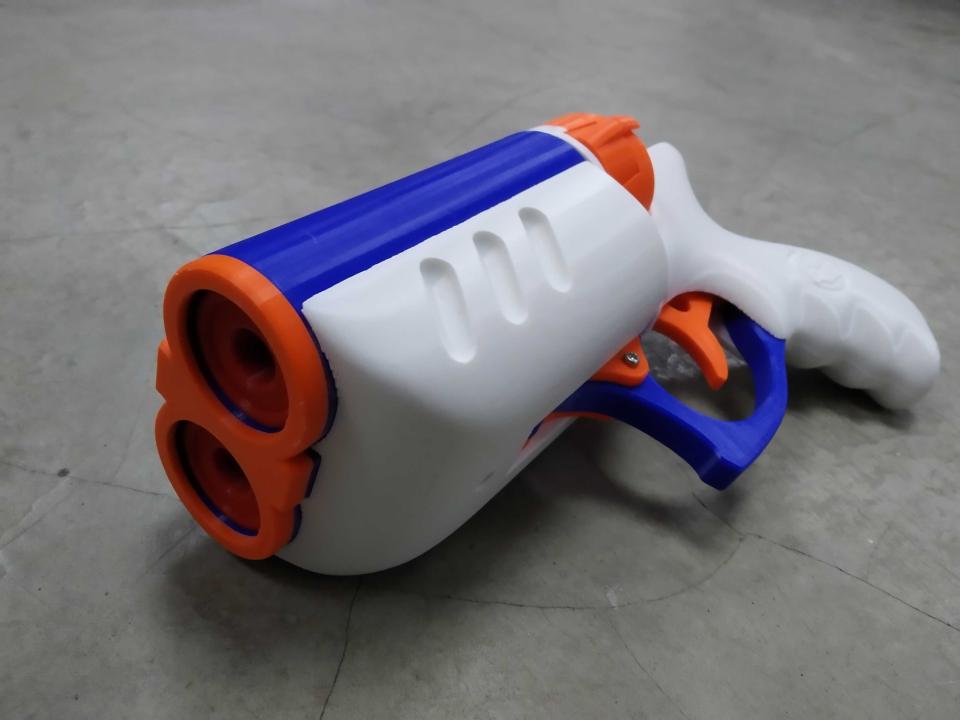
Do Nerf guns need batteries? Only the electric ones. A flywheel cage has no shot without a pack: two motors have to spin the wheels before a dart arrives. A springer such as the Worker Seagull, Worker Harrier, XYL KM9 Unicorn or Firefly primes by hand and does not. Rewiring a Nerf blaster is how you keep those motors at the voltage the cage was designed around once current rises. It is electrical work, not a universal upgrade, and there is no one schematic for an unknown shell. Hasbro’s manuals say do not modify the blaster; aftermarket platforms document connectors and boards they support. Use that documentation, or a technician, rather than a forum drawing.
Voltage sag is the reason you rewire
Wire has resistance. Current through resistance drops voltage (Ohm’s law). Under load the motors see less than the pack’s rest voltage; the wheels slow; the next dart gets a weaker pinch. That feels like inconsistent range, not a dramatic failure. Stock ribbon wire and a small connector were sized for mild current. Hotter motors, a higher cell-count pack, or full-auto dumps pull more amps, so the same wire sags more. Thicker, shorter runs of flexible silicone reduce that drop. Gauge is a trade against what the shell can actually route: a number copied from another cage can be too fat to close, or too thin for the current you just added.
American Wire Gauge is backwards in conversation: a smaller number is thicker. Hobby flywheel rewires often land in a 16–18 AWG band, while stock leads can be much finer. That is why people change wire, not a specification for your shell. Match the current the documentation implies, leave slack for the shell to close, and do not sandwich insulation in a screw boss.
Polarity, fuse, XT30 and XT60
Polarity is not optional. Red to the documented positive, black to negative, verified with a meter before the first power-up. Reverse a pack into a MOSFET and you can kill the transistor instantly. A MOSFET is a low-side switch that keeps motor current off the trigger contacts — see what a MOSFET is — and it is part of a high-current rewire, not a substitute for one.
Put an inline fuse near the pack, on the positive lead, so a short in the cage or a pinched negative does not dump the whole cell stack into a melted harness. Fuse rating belongs to the documented current of that build, not a random automotive blade from a drawer. The connector is how you keep that fuse and those motors attached without a Tamiya-style high-resistance joint. XT30 is common on compact bays — the Hare Diana is specified with XT-30. XT60 is the larger sibling used when current and space allow. Deans, Tamiya and others exist. The plug is not compatibility proof: an adapter does not change voltage, cell count or discharge capability. Use the pack and charger the product names. Nominal LiPo is 3.7 V per cell; full charge about 4.20 V; storage typically 3.75–3.85 V. Charge attended, on a non-flammable surface, with a balance charger. Retire swollen, leaking, hot or damaged packs. C-rating is a discharge-capability figure, not a power upgrade. More on choosing a pack is in how to choose a LiPo.
What a rewire is not
| You are doing | You are not doing |
|---|---|
| Cutting voltage sag so motors keep speed between shots | Adding FPS by magic; FPS is crush, dart and voltage at the wheels |
| Moving high current off trigger contacts (usually with a MOSFET) | Installing a mystery board from another hobby “because FET” |
| Fusing the pack and locking polarity | Skipping a fuse because the old wiring had none |
| Using XT30 or XT60 as the product or bay documents | Proving compatibility with an adapter lead |
| Routing so the shell closes without pinching | Copying a 16 AWG diagram into a shell that cannot fit it |
Do not rewire a springer “just in case”. There is nothing to switch. Do not change the pack while you rewire unless the complete configuration — cage, motors, MOSFET, connector, bay — is documented together. A 3S pack from a drone is not a Nerf upgrade. Motors come after wiring: hotter cans on sagging leads just heat the harness. That order is in the modding roadmap and the motor guide.
Routing inside a real shell
- Disconnect and remove the pack using the product procedure. Confirm it is not swollen or damaged.
- Photograph the stock layout before you cut anything. You will want that picture.
- Plan MOSFET location, fuse, and connector so the shell can close. Dry-fit before you solder.
- Solder or crimp to the component documentation. Strain-relieve every joint. No bare strands.
- Verify polarity with a meter. Check for shorts from motor cans to the cage or to the positive lead.
- Close the shell without nicked insulation. If a wire is pinched, open it and redo the route.
- First power-up is a brief rev in a controlled area, rated eyewear on, pack in a fire-aware setup. Stop on heat, smell, or a cage that stays live.
If any step is unclear for your exact blaster, stop. Unknown shells do not get a pinout from this page. Test with the correct dart length, a safe backstop, and rated eyewear (Z87.1 / EN 166). Hasbro: do not aim at eyes or face.
Frequently Asked Questions
What wire should I use to rewire a Nerf blaster?
There is no universal gauge. Use wire, insulation and a current capacity that the exact blaster, motors and pack documentation support, routed so the shell closes. Copying 16 AWG from another cage is not a specification.
Do Nerf guns need batteries?
Flywheels and other motorised blasters do, every shot. Springers do not. If you are rewiring, you already have an electric machine — carry a charged pack that the product names, plus LiPo habits.
Can I change the battery while rewiring?
Only as part of a complete documented setup. Do not infer a cell count from another build. Connector adapters are not a voltage change.
Do I need a MOSFET in the rewire?
When current is going up, yes — to keep that current off the trigger contacts. It still does not add FPS. Mild stock current may not need one. Fit only a unit documented for that wiring.