
Nerf Modding: The Complete Roadmap From Beginner to Advanced
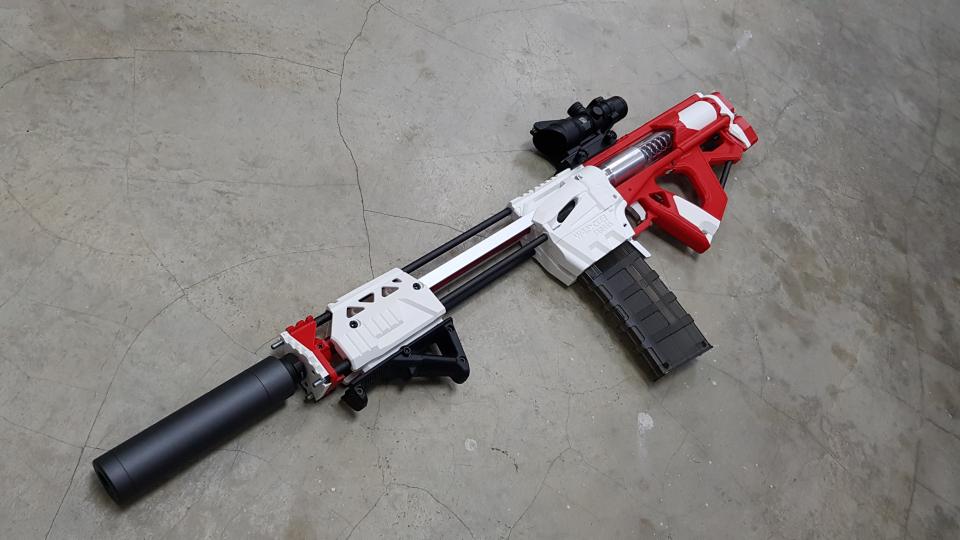
Nerf modding is changing a foam-dart blaster after it leaves the box — ammo, magazines, seals, springs, cages, wiring, motors and packs — in a documented order so each change can be tested. It is not required, and it is not always permitted. Hasbro’s product manuals say do not modify darts or blaster; that is the manufacturer position. Aftermarket platforms such as the Worker Seagull, Worker Harrier, XYL KM9 Unicorn, Hare Diana, Monkee Mods Firefly and ZWQ publish which parts they actually support. This roadmap is that hobby practice, not a licence to ignore the organiser sheet, Malaysian law or the exact product documentation.
People searching what Nerf gun shoots the hardest usually want a number. Muzzle energy is ½mv² — FPS is not energy, range or safety, and there is no universal “safe FPS”. The organiser’s chrono method and test dart win. Hardest in practice means consistent at the cap, with darts that still fly straight.
Start stock, then fix the ammo
Chrono and group the blaster as it arrived, with one dart type, before you buy a spring or a motor. Mixed foam fakes every hardware fault. Full-length and half-length darts are not interchangeable — even Hasbro Pro half-dart magazines are not all cross-compatible. Match magazine, feed path and dart length. A Seagull, Harrier or Unicorn is only as good as the Talon mag you can reload; a Diana magazine is not a Talon.
Rated eyewear is not optional once energy goes up. Look for ANSI/ISEA Z87.1 or EN 166 marks; sunglasses are not a substitute. Do not paint a blaster to look like a firearm — Hasbro’s Pro manuals warn that alteration can confuse law enforcement, and Malaysian public-carry attention is not theoretical.
Mechanical work: seals, springs, cages
A springer stores the shot in a spring and dumps it through a plunger as a pulse of air. First jobs are air seal and a spring the platform lists. The Harrier 1.6, Firefly 5–12 kg ladder, and Seagull spring/barrel pairs are different lengths and threads — not interchangeable. Over-springing a thin plunger or stock catch is how a reliable blaster becomes a paperweight. A BCAR200 (about 8° / 200-class) or BCAR300 (about 18° / 300-class) is chosen by measured FPS, not by the word “sniper”.
A flywheel has no plunger on the shot. Two wheels in a cage grab the dart and throw it. Mechanical work here is cage screws, wheel concentricity and crush — how hard the foam is pinched — plus dart length. Crush is a tune, not a millimetre you copy from another cage. Do this before motors. Details live in how to tune flywheels.
Electrical work, then the pack
Only flywheels have this layer. Raise current — hotter motors, higher voltage, full-auto — and stock contacts arc and the wire sags. A MOSFET is a low-side switch that keeps motor current off the trigger contacts; it is not an FPS part. Rewire for voltage sag, gauge, polarity, a fuse and a real connector (XT30 on compact bays such as the Diana, XT60 on higher-current rifles) before you chase cans. There is no one schematic for an unknown shell. See what a MOSFET does and how to rewire.
The pack comes last. Use the battery and charger the product names. Cell count is not a shopping code. Charge attended, on a non-flammable surface, with a balance charger; store around 3.75–3.85 V per cell. A pack that swells, leaks or runs hot has reached end of life — stop using it. C-rating is discharge capability, not a power upgrade, and the connector is not compatibility proof.
The order that does not waste a build
| Stage | What you change | What you are proving |
|---|---|---|
| 0 — Stock baseline | Nothing. One dart type, chrono, group. | The machine works and you know its number. |
| 1 — Ammo and magazines | Matched foam and mag pattern. | Jams were foam, not hardware. |
| 2 — Mechanical | Seal/spring or cage/wheels, then a BCAR if chrono supports it. | Air path or pinch, not “more power”. |
| 3 — Electrical | Wire, fuse, connector, MOSFET if current is rising. | Motors see the voltage the cage was designed around. |
| 4 — Battery last | The pack the product names. | Voltage, plug and bay match. Not a random cell count. |
Change one variable at a time. If you swap spring, barrel and darts on the same afternoon, you will not know which one threw the group. Stop if a part does not fit, wiring is pinched, the blaster overheats, smells, or behaves erratically. Keep the original parts. The parts order is expanded in best Nerf upgrade parts; the mistakes that skip this order are in common Nerf modding mistakes.
Hasbro position versus hobby practice
Hasbro’s typical instructions: do not aim at eyes or face; eyewear recommended (Pro: always required); use only darts designed for the product; do not modify darts or blaster. Age marks are product-specific (often 8+; some Pro models 14+ and “this is not a toy”). Colour or a private field does not settle legal status in Malaysia — confirm the exact item with PDRM or qualified legal advice. This site is not legal advice. Hobby practice on aftermarket platforms is still real: those makers document springs, cages, magwells and packs. Stay inside those lists. A stock Seagull or Unicorn that cycles cleanly is already a finished blaster.
Frequently Asked Questions
Is Nerf modding safe for beginners?
Ammo, magazines, and mechanical parts the exact platform lists, one change at a time, with chrono and rated eyewear. Electrical work is not a first weekend. Use a technician when documentation is incomplete.
Are LiPo batteries dangerous in Nerf blasters?
They need attended charging, storage voltage, and retirement when swollen, leaking, hot or damaged. Use only the pack the product names. A springer such as the Unicorn or Seagull does not need one.
What Nerf gun shoots the hardest after mods?
There is no SKU that wins. Hardest is a chrono reading on a named dart, under the organiser’s method, at or under the field cap. FPS is not energy and is not range.
Do I have to mod at all?
No. Reliability, matching darts and eyewear beat a half-finished wiring job. Mod when a documented part solves a problem you have already measured.
In-depth guides in this series
- How to Mod a Nerf Blaster
- What Is a MOSFET?
- How to Rewire a Nerf Blaster
- Nerf Motor Upgrade Guide
- How to Tune Flywheels