
How to Tune Flywheels
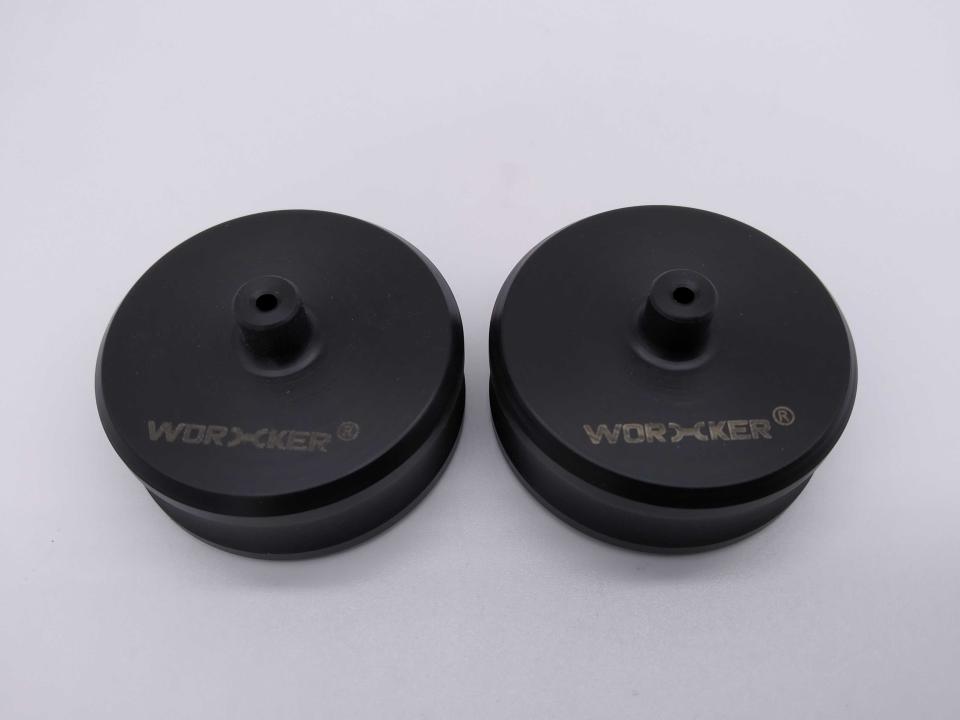
Flywheel tuning is setting the pinch, the cage and the dart so two spinning wheels throw foam straight instead of chewing it. Crush, concentricity, cage screws, dart length and dirty wheels are the whole job. There is no universal millimetre of crush that fits every cage, and a hotter motor will not rescue a pinch that is wrong. Hasbro’s manuals say do not modify the blaster; aftermarket cages document which wheels and darts they support. This is that hobby tune, not a parts list for an unnamed shell.
Crush is a feel, not a millimetre recipe
Crush is how much the dart is compressed between the two wheels. Too little and the foam slips: low speed, a chewed tail, a dart that leaves tumbling. Too much and the motors labour, the dart deforms in the pinch, heat climbs, and range falls even though the cage sounds angry. The gap you want is the one that grips this dart, in this cage, at the voltage the motors actually see. Copying “0.something millimetres” from another brand of wheel is how people stall a cage that was never cut to that number.
Change crush only the way the cage documentation allows — shims, wheel profile, or a cage the platform lists — then chrono with one dart type. If you change crush and motors in the same hour you will not know which one shredded the foam. Motors come after the pinch is boringly consistent; that order is in the motor upgrade guide and the modding roadmap.
Concentricity and cage screws
Each wheel must run round on its shaft and the two shafts must stay parallel. A wheel that is not fully seated, is out of round, or has a chunk missing will throw a wobble into every dart. That looks like a random spray, not a consistent left miss. Concentricity is why you replace wheels as a pair when one is damaged, and why a “service” flywheel-with-motor on a Hare Diana is a matching assembly rather than a mix-and-match can from a drawer.
The cage is not a barrel. It only has to hold those motors parallel and keep the pinch centred. A cracked cage, a missing screw, or a screw that bottomed in a stripped boss lets one motor toe in or out. The dart then leaves at an angle: high, low, or sideways, which people blame on “weak batteries”. After a drop, check the screws before you buy anything. Tight means snug and even, not cranked until the plastic creaks. A loose cage is also the first hardware check in flywheel blaster losing range.
Dart length, foam condition, dirty wheels
The feed path was built for a length. Full-length Elite-style darts and half-length short darts are not interchangeable. A short-dart pusher will crumple a long dart in the pinch; a long-dart cage usually will not chamber a stub. Hasbro’s Pro half-dart magazines are not all cross-compatible with one another either — “half dart” is a family, not a standard. Match magazine, pusher stroke and dart, then keep that combination together. Banana-shaped, crushed, or glue-heavy foam will slip or stall no matter how pretty the wheels are.
Wheels pick up dart dust, tip residue and Malaysian humidity film. Glazed rubber or plastic slips, then suddenly bites and shreds. Clean only with the method the cage or wheel listing allows. Do not soak unknown plastics in a solvent that is not named for them. If the tread is flat, chunked or polished smooth, replace the wheels the platform documents — cleaning will not grow rubber back.
A tune checklist that stays honest
| Check | You are looking for | Wrong fix |
|---|---|---|
| Dart length and condition | One length, straight foam, matching mag | Hotter motors on mixed junk |
| Cage screws and cracks | Parallel motors, no toe, no rattle | A new pack for a sideways group |
| Wheel concentricity | Fully seated, round, a matched pair | One replacement wheel of a different profile |
| Crush on this dart | Grip without stall or a chewed tail | A millimetre copied from another cage |
| Dirty or glazed wheels | Tread that still grips | Solvent that the listing does not name |
| Pack voltage under load | The pack the product names, not sagging mid-string | A higher cell count “to add crush” |
A MOSFET and a rewire keep voltage at the motors; they do not set crush. Use the pack the product names — the Diana’s XT-30 3S/4S options are that pistol’s documentation, not a rule for every cage. Charge attended; retire swollen packs. Springers (Seagull, Harrier, Unicorn, Firefly, ZWQ) have no flywheels to tune; if you opened one looking for a cage, you have the wrong machine. Test with rated eyewear (Z87.1 / EN 166), a safe backstop, and the organiser’s chrono method. There is no universal safe FPS. Hasbro: do not aim at eyes or face.
A BCAR200 or BCAR300 sits after the cage already groups. Choose the twist by measured FPS (about 8° / 200-class versus 18° / 300-class), not as a way to hide a bad pinch. How the cage launches in the first place is in what a flywheel blaster is.
Frequently Asked Questions
What flywheels should I use?
Only wheels documented for that cage and dart length, as a matched pair. Profile and durometer are cage-specific. A wheel from another brand can change crush in a way the motors cannot live with.
Is there a crush measurement I should set?
No universal millimetre. Set crush so this dart grips without stalling the motors you actually run, then chrono. If the documentation gives a procedure, follow that — not a forum gap.
Can I improve the tune with a different battery?
Only the pack the blaster names, or a documented equivalent for that cage, connector and bay. Extra voltage is not a crush tool. It can over-speed motors and arc a stock trigger.
Why does a tuned cage still chew darts?
Usually dart length, already-damaged foam, or crush that is still too tight for that dart. Hotter motors on a bad pinch shred faster. Fix foam and pinch first.